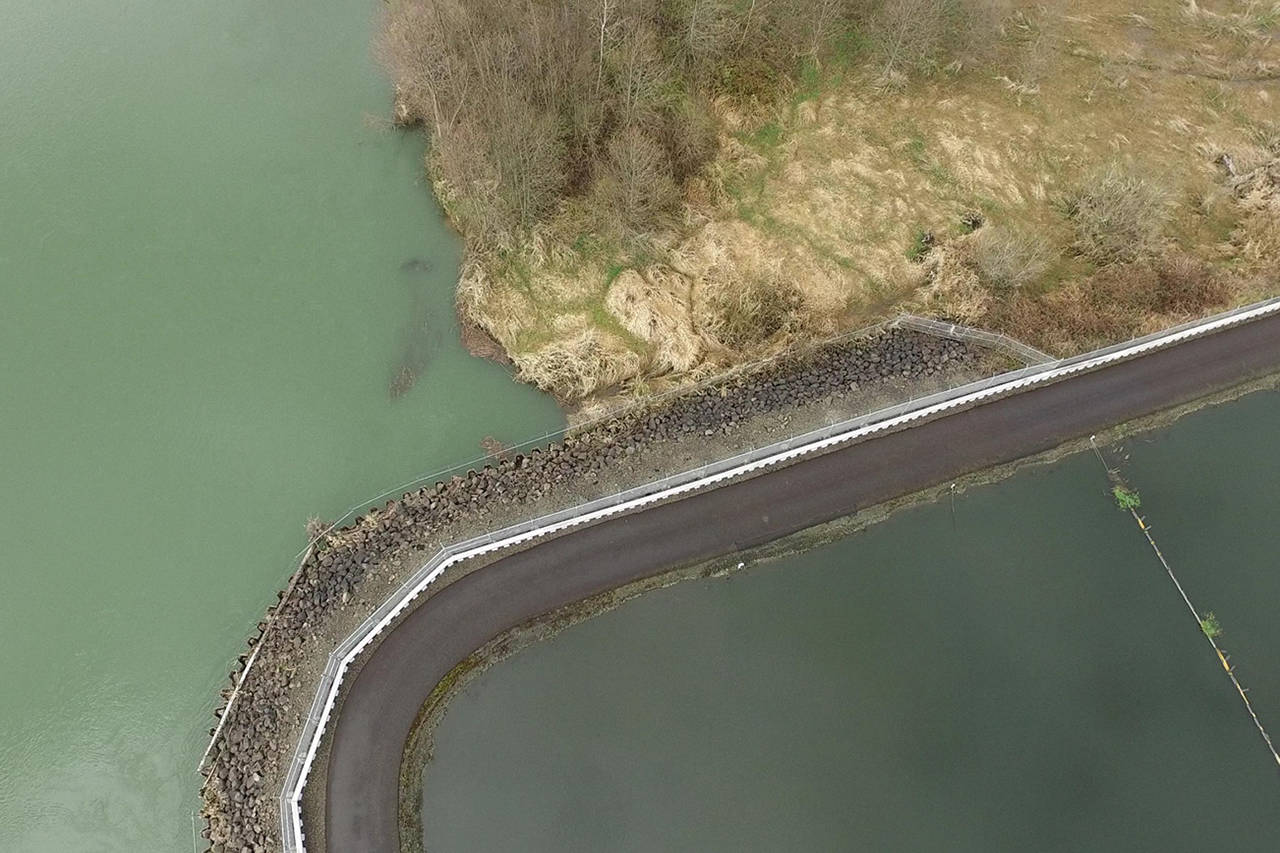
Montesano’s waste water treatment facility has been deemed an ecological disaster in the making, but the solution is being held up by the state budget.
Currently, the city and the Chehalis River Basin Flood Authority have not entirely settled on a plan to ameliorate the issue. The Wynoochee River has been eroding the river bank along the facility and now is touching the northwest corner of the facility.
“Environmental disaster is not an overstatement,” said Montesano City Councilman Dan Wood. “Take a human waste lagoon and it breaks loose into the river, you’re talking about affecting fish and wildlife, and water quality in general. If that breaches and goes into the river, it goes into the Wynoochee and to the Chehalis River and then to Cosmopolis. I’ve spoken to the mayor of Cosmopolis, and he prefers not to have our waste, and we’re going to try to not give it to him.”
In the state’s capital budget — which was not passed during the 2017 Legislative session, nor during subsequent special sessions — $5 million is allocated toward a project to address the erosion.
At this point, the city and the flood authority seem to be leaning toward one particular solution — “river jacks” likely will be placed along the river bank. River jacks are man-made structures constructed of a boulder and wood beams. As the bank erodes, the river jacks naturally fall in the water and they then collect and trap sediment. As more jacks fall into the water, they collect more sediment. As the sediment builds, the river’s current has to slow or redirect. The jacks will be positioned to redirect the stream away from the facility.
A second phase of the plan would include opening a relic channel (a route the river used to travel on but now is blocked off) on property owned by the Department of Fish and Wildlife.
Overall, that plan will cost an estimated $8 million.
Montesano public works director Mike Olden says there are two ways to address the situation: protect the current site, or build a new facility inland.
The river jacks will fortify the current facility enough to extend its life by some 9 years. Olden called that estimate “conservative,” meaning it could extend the life a lot longer.
Another solution would be to build a new facility. That would cost about $20-30 million.
Building a new facility, however, doesn’t mean the city could just retire the old facility and move on.
“Another factor that comes into play is we have our outfall pipe to the Chehalis River to this site. So we can’t abandon it because we have to protect that too,” Olden explained.
Councilman Wood has been leading the way for the city in terms of securing funding and a solution to address the bank erosion since he took office in early 2016. He agrees with Olden, saying that if a new facility were to be built, the city still would be on the hook.
“We’d still be battling river because the infrastructure to the outfall is still there,” Wood said. “We would still have to battle to keep that piece of land from being eroded and turned into an island.”
Building a new facility is doubly expensive, Wood suggested saying, “It would cost us the cost of a new treatment plant, plus $5-8 mil in battling the river. That makes it two expensive projects instead of one.”
In the past decade, walls have been built along the river bank. While those walls worked to protect the facility initially, the river has continued to erode down and could be undercutting the wall.
“Sheet pile is there now, and the river is 40 feet deep,” Wood said. “The pile wall creates a deep hole. It’s possible that sheet pile wall gets eroded at the base. I don’t know there was anticipation of there being a 40-foot hole there.”
But that sheet pile wall did serve a purpose, Chehalis River Basin Flood Authority’s Scott Boettcher said.
“The original fix gave people breathing room,” Boettcher said.
The solution, like many other projects in Grays Harbor County and statewide, is held up in the state capital budget. The funding is there, but now state lawmakers have to agree to approve the budget. So far, that hasn’t happened.
But while the project waits for state funding, Boettcher says he and Wood are working to ensure support from the various entities that would have say in the decision.
“We took time to engage the Department of Fish and Wildlife, the Quinault Indian Nation, the state Department of Ecology, and all of the entities involved because when funding came up we needed everyone on board,” Boettcher said. “Whenever we get this capital budget, we have funding, know exactly what we’re going to do, and it’s on everybody’s radar screen. Hopefully time we spent on the front end will pay us back on the back end when we move into construction.”
Boettcher said everybody involved is hoping the situation can be solved by the beginning of flood season in 2018.
“If the capital budget passes this session — it’s still several months away — we can use the time between now and then to get the permit process completed and into agencies so the project can move into construction in late summer when fish windows allow,” Boettcher said. “By next flood season we should have a solution in place and everybody can breathe a sigh of relief.”
Olden noted that the situation is dire and the city is trying to address it from several perspectives.
“The tricky part of this world is there is a real potential serious environmental problem that could arise out of a failure of what we have out here, but it is also the responsibility for us to protect the citizens from the economic side of that,” Olden said. “You see a mix of that. We have a good start on hunting down resources.”
Simple math — $5 million from the state capital budget for an $8 million project — shows the city on the hook for some $3 million. Olden said the city is looking at other sources of funding including loan options.
In the end, however, residents will end up footing the bill and could see that in their utility rates, Olden warned.
“It could lead to potentially doubling the rates,” Olden said. “We’re doing everything to keep that from happening.”
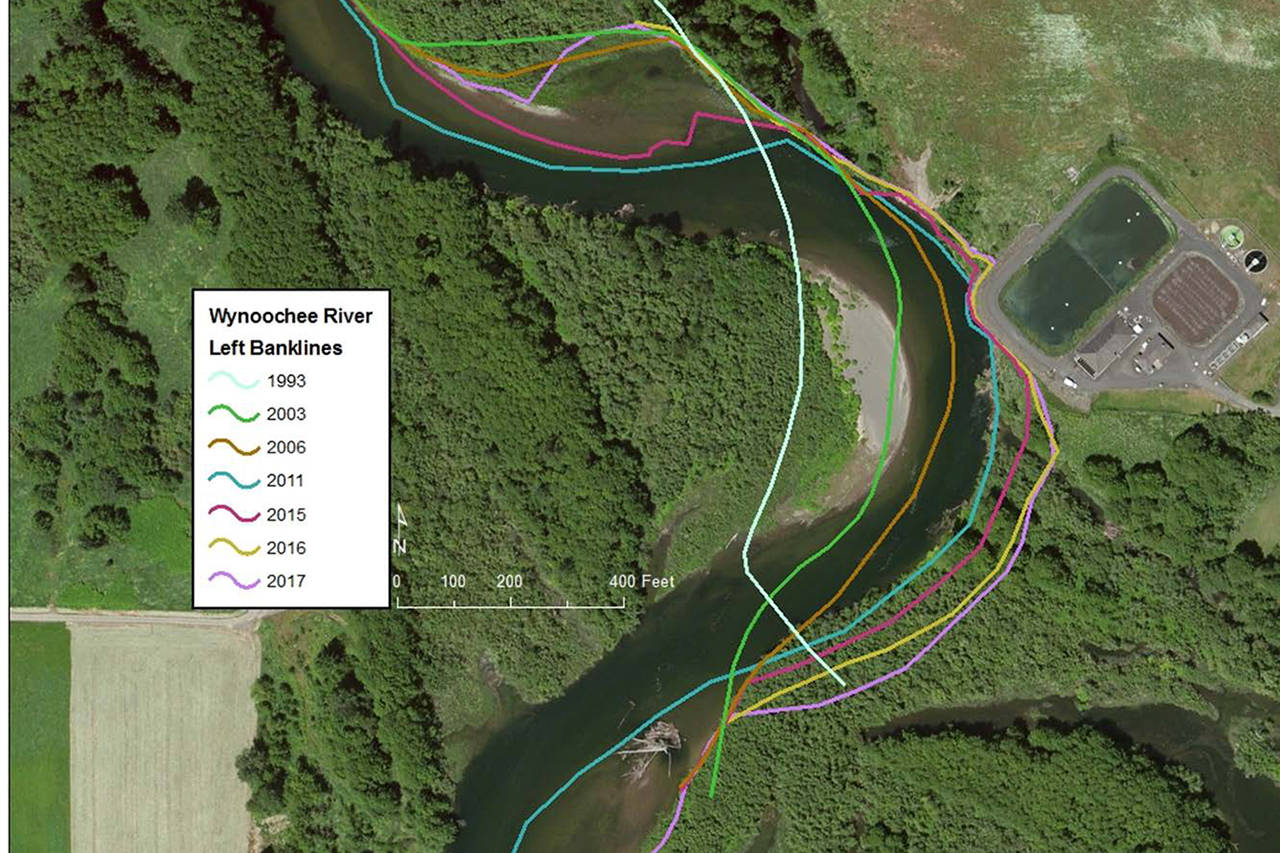
An image provided by the Chehalis River Basin Flood Authority shows the historical migration of the Wynoochee River.